
A mushroom has neither roots nor chlorophyll, yet it shares a complex taxonomic history with plants. The fern, on the other hand, does not produce seeds, unlike the pine, which belongs to the same kingdom. Algae, once classified among plants, now encompass organisms with independent evolutionary lineages.
The classification of plants results from a succession of scientific revisions, regularly disrupting the boundaries between groups. The fundamental distinctions are based on reproduction, cellular organization, and the presence of specialized tissues.
Understanding the diversity of major groups of plants
It is impossible to reduce the plant kingdom to a simple collection of plants encountered throughout the seasons. Research on classification has highlighted several fundamental types, revealed through morphological, anatomical, and molecular approaches. This diversity is expressed through profound variations in the structure, reproduction, and adaptation of plants to their environment.
Researchers agree on an organization at several levels. Among them, non-vascular plants like mosses occupy a distinct place. Lacking true conducting tissues, these witnesses of the early conquest of land remind us how decisive the transition out of water was. In contrast, vascular plants, ferns, gymnosperms, and angiosperms, possess sophisticated internal systems that ensure the transport of sap through xylem and phloem. This innovation has allowed for spectacular expansion across continents.
Here are the major groups that structure plant classification:
- Mosses: have neither roots nor true stems and leaves; they primarily live in wet areas.
- Ferns: equipped with conducting vessels, they reproduce by spores without forming seeds.
- Gymnosperms: produce exposed seeds, adapting to various environments.
- Angiosperms: distinguished by the presence of flowers and fruits, they currently occupy most terrestrial habitats.
Those who wish to explore further can consult the main groups of plants to grasp the overall logic: from the modesty of mosses to the colorful profusion of angiosperms. Understanding these structural and functional distinctions means grasping both the evolutionary dynamics and the extraordinary adaptability of plants.
What scientific criteria distinguish the main plant categories?
The delimitation of major groups of plants is based on well-established criteria. It all begins at the level of the plant cell: cellulose wall or not, organization of the nucleus, presence of specialized plastids… each characteristic counts in the classification.
At a higher level, the formation of tissues marks the separation between vascular plants and simpler lineages. The former develop conduction systems, xylem and phloem, which ensure the circulation of sap and facilitate their establishment away from humid environments, while mosses or liverworts, deprived of these networks, remain dependent on high ambient humidity.
To better understand these criteria, here are the main points retained by modern botany:
- Tissue organization: appearance of vessels, differentiation between roots, stems, and leaves.
- Vegetative growth mode: ability to form roots, trunks, branches according to the groups.
- Cellular specialization: development of cells dedicated to photosynthesis, protection, or transport.
The classification of plants also takes into account the ability to reproduce these structures from one generation to the next. The appearance of elaborate reproductive organs such as flowers or cones indicates an additional level of evolution. By crossing these criteria with genetic data, researchers refine the understanding of different types of plants and highlight the richness of the plant kingdom.
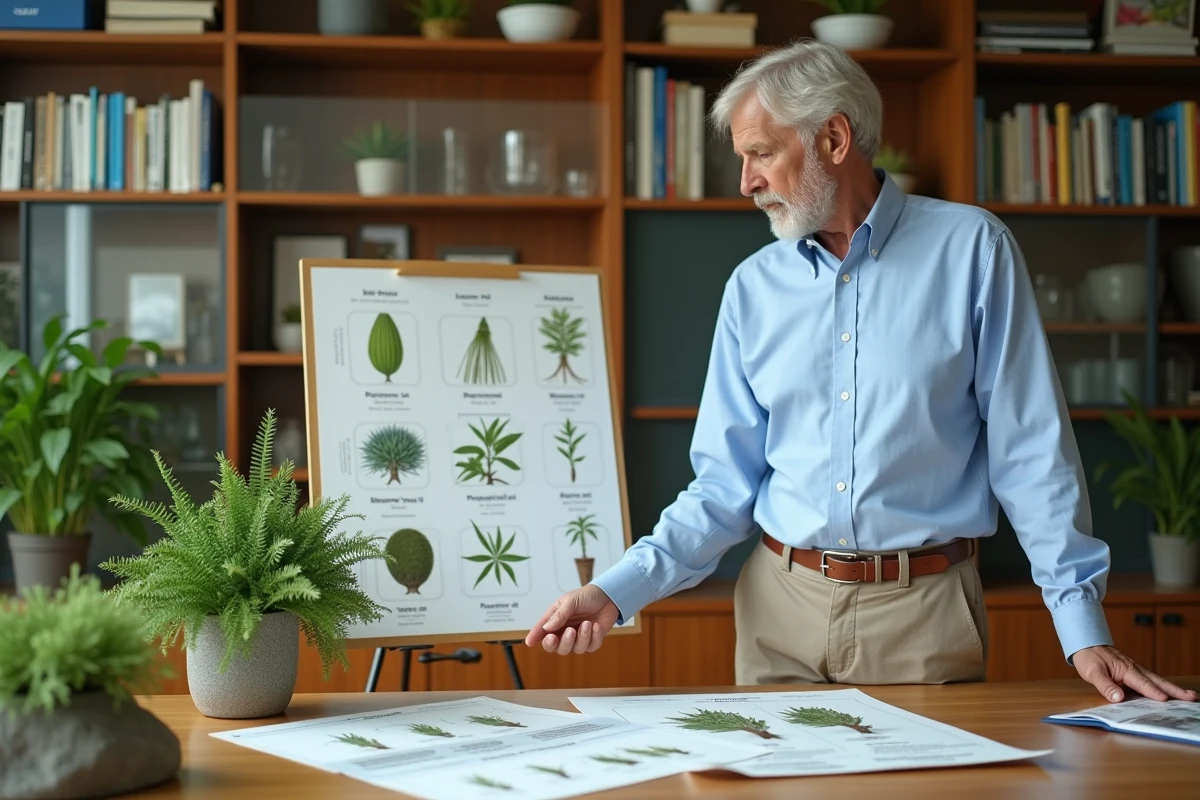
The essential differences between mosses, ferns, gymnosperms, and angiosperms
Looking closely at mosses, ferns, gymnosperms, and angiosperms reveals four ways of responding to the challenges of terrestrial life.
First to emerge from the water, mosses have neither roots nor vessels. Their structure remains simple: a modest stem, rudimentary leaves, with water and minerals absorbed through the entire surface of the plant. Lacking a protective cuticle or absorbent hairs, they cling to moisture, unable to venture into overly dry environments.
Ferns take a step forward: they have roots and conducting vessels, xylem for raw sap, phloem for elaborated sap, which ensure internal circulation. Their leaves, sometimes spectacular, betray a more advanced organization; they feature the first differentiated organs, precursors of plant complexity.
Next come the gymnosperms: pines, firs, cypresses. Their strength? Solid wood, deep roots, needles capable of withstanding cold or drought. The thick cuticle limits water loss, and reproduction occurs through cones, independent of the presence of water for fertilization.
Finally, angiosperms usher in a new era. Flowers, fruits, leaves of various shapes, an efficient internal network of vessels, stomata to manage exchanges with the air. This vast group includes both discreet herbaceous plants and remarkable trees. Their structural and reproductive inventiveness has propelled them to the top of the plant kingdom and continues to shape our landscapes.
Through this diversity, we measure the creativity of life and the ability of plants to continually invent new ways to anchor themselves on Earth.